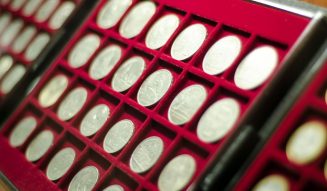
Pierre Buhot, an amateur collector and member of the Delcampe website, presents this exclusive article on US Large Cents. We thank him for this comprehensive and highly interesting study.

When American coins tell the story of a nation.
“From the Revolution to the Gold Rush, how a simple copper coin shaped the economy and identity of the United States.”
Copper giants at the heart of American history
Imagine a coin so heavy that it becomes cumbersome, so expensive to produce that it nearly bankrupts the state, and so symbolic that it alone embodies the hopes of a young Republic. Welcome to the world of the Large Cents, those copper giants that circulated in Americans’ pockets for over 60 years, from the battlefields of 1812 to the saloons of the Gold Rush!
In 1792, under the presidency of George Washington, the Coinage Act established the United States Mint in Philadelphia. By 1793, the first federal coins were minted, including the copper Large Cent, a symbol of the monetary sovereignty of a young Republic born in 1776. These 13.48 g copper giants (29 mm in diameter) – hence their name, the Large Cent – were the first ambassadors of American monetary sovereignty. Yet they were struck in haste and improvisation.
The chaotic beginnings of the Flowing Hair
As early as 1793, the first federal coins were rolling off the presses… or rather, from an old brewery! Lacking dedicated premises, workers struck the Large Cents using machines imported from England, powered by hand, and often sabotaged by poorly trained workers.
They were operated by human power (2 to 3 workers per press). The dies for the first Large Cents of 1793 were engraved in steel using chisels, then tempered to harden the metal; they wore out quickly (after 5,000 to 10,000 strikes), which explains the variations in quality.
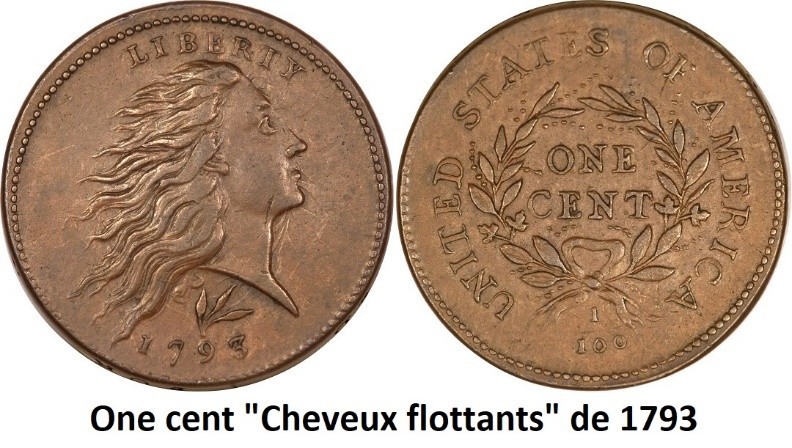
One cent 1793 ‘Flowing Hair’: First design, featuring an allegory of Liberty with flowing hair, symbolising the Revolution
The first blanks (metal discs cut from copper plates imported from England) weighed between 13 and 14 grams, but their thickness was not always uniform. Many 1793 Large Cents feature minting errors, such as upside-down letters or irregular edges. Ironically, these minting flaws, once considered errors, now make them ultra-rare and highly sought-after coins!
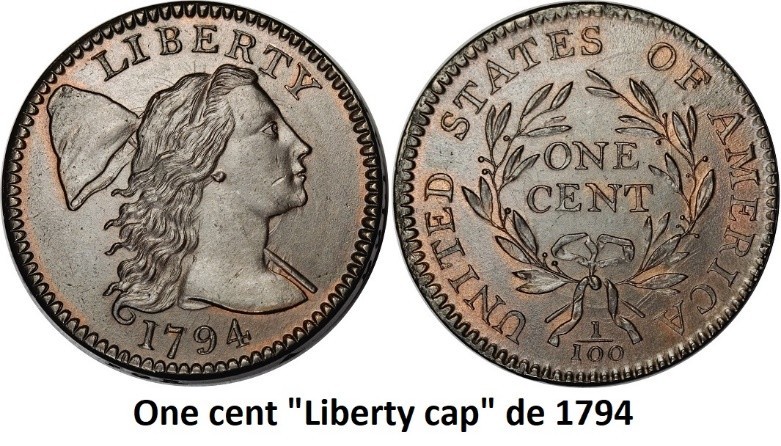
One cent 1793–1796 ‘Liberty Cap’ (Bust of Liberty, a Phrygian cap behind her head).
Whilst the Flowing Hair coins of 1793 marked the chaotic beginnings of the Mint, the following years saw a first attempt at standardisation with the introduction of the Liberty Cap.
1796–1807: The era of the Draped Bust and screw presses
In 1800, metal screw presses arrived at the Philadelphia mint, gradually replacing the wooden presses and enabling more precise and powerful striking. As a result, the Draped Bust features much finer details than those of the 1793 Flowing Hair, also symbolising a Republic that was taking shape.
Note: In certain years, such as 1802, 1804 and 1811, production of Large Cents was very limited, making them extremely rare coins today.
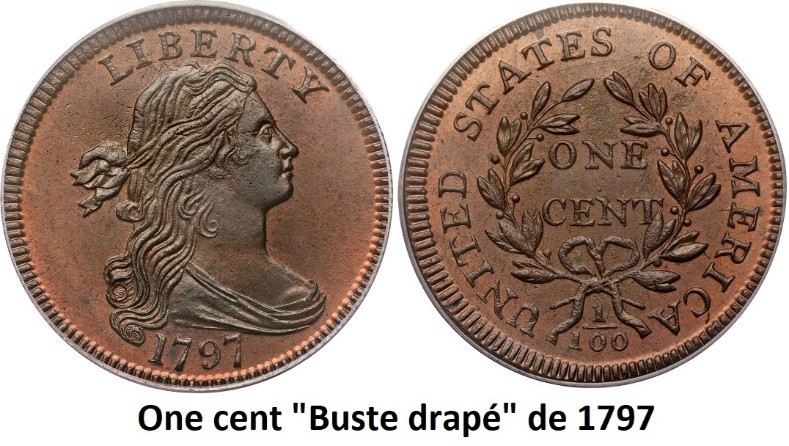
One cent 1796 to 1807 ‘Draped Bust’ (Draped bust and long hair).
For example, only a few thousand examples of the 1804 Large Cent were struck, and some numismatists believe that certain coins were struck illegally after that date. Furthermore, in that year, several coins were struck with broken dies.
Historical context: In 1803, the purchase of Louisiana from France for $15 million doubled the size of the United States, opening up new markets where Large Cents would circulate.
1804–1806: The Lewis and Clark expedition explored the West, paving the way for American expansion.
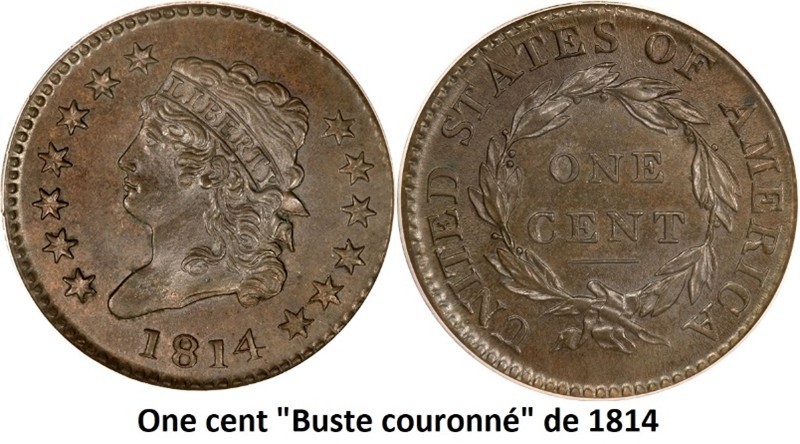
One cent 1808 to 1814 ‘Capped Bust’ (Crowned bust, more structured hairstyle).
1808–1814: The Capped Bust and the War of 1812
A key event of this period, the Anglo-American War against the United Kingdom (1812–1815) strengthened American nationalism.
1816–1839: The Coronet Head era and the fight against counterfeiting
Note: These coins were also targeted by counterfeiters! In 1820, it was estimated that up to 50% of the Large Cents in circulation were counterfeits, struck with homemade dies. To combat this, in 1816 the Mint introduced more pronounced reeded edges and micro-details on the dies – such as the small stars around Liberty’s head. Historical account: In a letter from 1820, a Boston merchant wrote: “Nobody wants these big copper cents. Give me silver coins or nothing!”
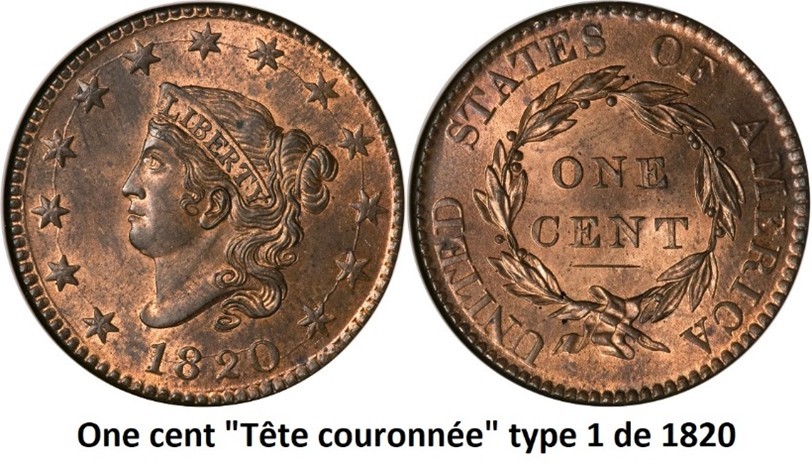
One cent 1816 to 1835 “Coronet Head Type 1 ” (Coronet Head)
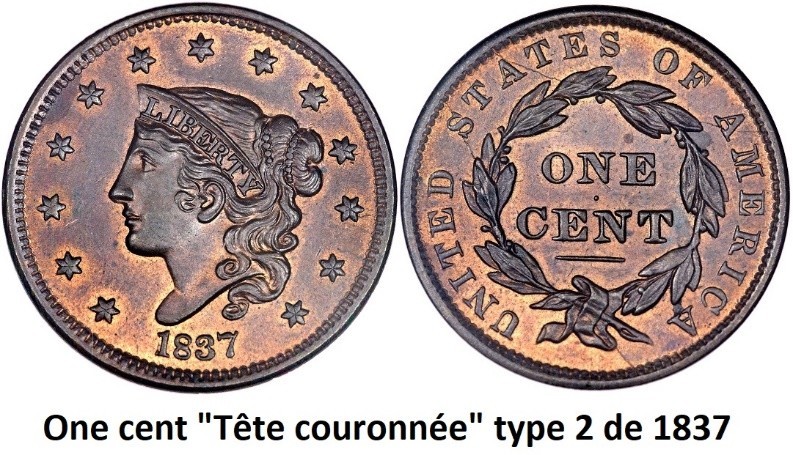
One cent 1835 to 1839 ‘Coronet Head Type 2’ (modification of Type 1, designed by a different artist).
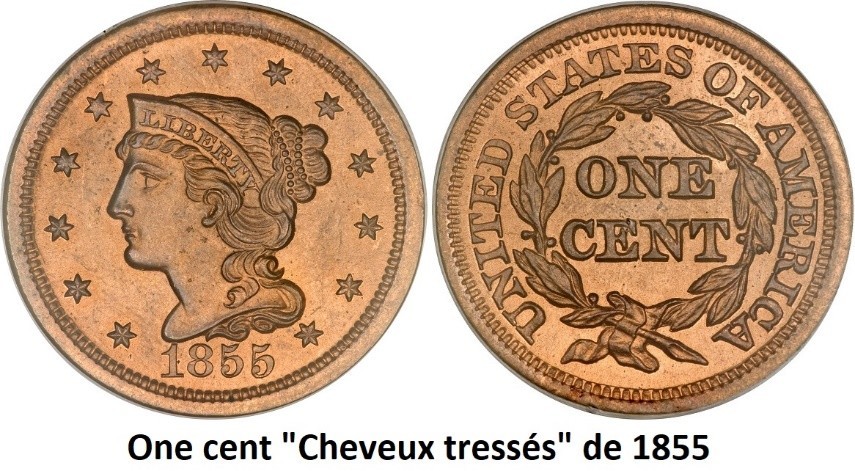
One cent 1839 to 1857 “Braided Hair” More sophisticated design, reflecting the influence of European fashions.
1839–1857: The Braided Hair and the Decline of the Large Cents
Technical mastery… and the end of an era
Key events of this period: 1848 : The California Gold Rush led to a massive influx of migrants and an increased need for currency. At the time, a Large Cent could buy a loaf of bread, a newspaper, or a glass of whisky (12 cents in 1850). In a country where the average worker’s wage was 50 cents a day, these coins were essential to local trade – hence their rapid wear and tear and their importance in everyday life. In the saloons of San Francisco during the Gold Rush, Large Cents were sometimes called ‘copperheads’ in reference to their colour – and their weight! Some miners used them as poker chips, piercing them to stack them on iron rods.”
1845: Annexation of Texas; Large Cents are now in circulation as far as the Rio Grande.
1849: A significant rise in the price of copper due to industrial demand marks the beginning of the end… In 1850, minting a Large Cent cost 1.6 to 2 cents (compared to a face value of 1 cent). The following year, its weight was reduced from 13.48 g to 10.89 g, but this was not enough… The Philadelphia Mint struck the last copper Large Cent in 1857.
1857 and beyond: The end of a legend
It was the Flying Eagle Cent (1857–1858), later replaced by the Indian Head Cent in 1859—smaller in size (19 mm) and made of a copper-nickel alloy (cheaper)—that would take its place in the annals of history. The 1857 Flying Eagle Cent is now one of the rarest coins in the United States. Only around 2,000 were minted for circulation… and most have been melted down or lost. Finding one would be nothing short of a miracle!
Epilogue: A priceless numismatic legacy
Among famous collectors, Louis Edward Eliasberg (American financier and numismatist, 1896–1976) owned a specimen of every type of Large Cent (his collection was sold for millions of dollars).
As numismatist Q. David Bowers put it: “Large Cents are not just coins. They are time capsules, fragments of history that you can hold in the palm of your hand.”
Large Cents are America’s first ambassadors. They travelled in the pockets of pioneers, soldiers and miners, long before the dollar became a global currency. If these coins fascinate you, you’ll be pleased to know that some are still available to novice collectors. A Large Cent from the 1830s–1850s in good condition can be found on our website, an ideal way to own a piece of American history!
Bibliography :
- “The Early Copper Coins of America” – Sylvester S. Crosby (reference on Large Cents).
- “A Guide Book of United States Coins” – Kenneth Bressett (practical guide for collectors).